A catalogue you write
Rewards are whatever your house trades in: thirty minutes of extra screen time, picking Friday's movie, staying up half an hour later, an ice-cream outing, a friend sleepover, a mystery box with one in stock. Each has a picture, a cost in wool or money, optional stock, and a flag for whether a parent must approve it. A reward can be for everyone or for particular kids. Kids tap Ask for it; you approve, deny or mark it fulfilled from the queue; the inventory on My Flock remembers what they have earned.
A hundred ideas on the shelves
Not sure what to put in the store? Reward ideas opens a library of a hundred-odd examples on ten shelves — screens and games, treats and food, outings and adventures, privileges at home, time together, things to keep, making and doing, little ones, teens, big-ticket goals — each with a suggested price in wool or money and the ages it suits. Pick an age, tick what fits your house, add them all at once, then rename or reprice anything.
Wool into money
If a kid would rather have cash, set what one wool is worth under Settings — ten cents, a quarter, a dollar — and a Cash out card appears in their store. They pick how much, it waits for your approval like any request, and saying yes takes the wool and adds the money to their balance in one ledger line, ready for Shear Day. Turn it off and the card disappears; nothing already paid changes.
Inside the barn, with a goat
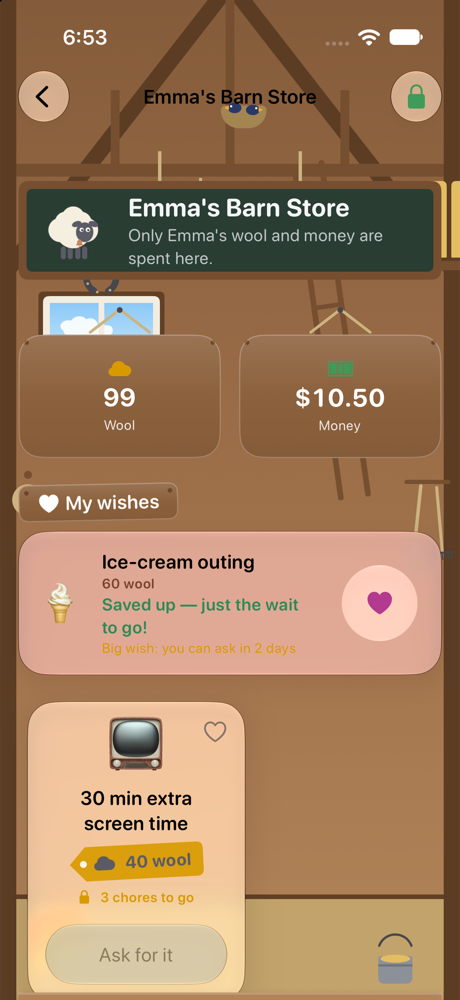
The store is the inside of the barn: plank walls under the rafters, a hayloft with a ladder up to it, a lantern on a rope that glows after dark, a window onto the meadow with the sky following the clock, a pitchfork and a rake on the wall, swallows in the beams and a cat asleep on a bale. The rewards sit on plank shelves, and a chalkboard hung from the beams says whose store it is — the kid's sheep and name — so nobody spends a sibling's wool. On an iPad held sideways the chalkboard and the balance signs take the left wall and the shelves the right. And a jealous goat hangs about the bottom of the screen wanting everything on the shelves: he peeks round the edge with narrowed eyes, tiptoes up to nibble a price tag until a SHOO! sends him off, sulks under a rain cloud, throws tantrums, charges a card head first and sees stars, turns up in a borrowed fleece going “baa?” as if nobody would notice, sits and daydreams of a prize in a thought bubble with hearts in his eyes, begs for it on his haunches with enormous wet eyes, carries in a bucket to stand on and still can't reach, floats up to a high shelf on a balloon until it pops, and sneaks in under a cardboard box with only his hooves showing. He also fishes for a price tag with a rod and line until it twangs back, tries a magic trick in a top hat with a wand in his teeth (abracadabra, a puff of smoke, still there), totters in on stilts and topples, serenades a prize with a guitar, dozes off under one dreaming of it, and pokes the sleeping cat for help — she wakes, arches and hisses him out of the barn. Between acts he blinks and flicks an ear. Tap him and he bolts. He never gets anything.
Unlock gates: no tablet until the chores are done
Tie a privilege to the board. A reward stays locked until the morning routine is approved, until everything due before a time is done, or until the whole board is done. Kids see the lock on their board and on the fridge chart with how many chores are left; you get a banner when it opens; and the Shortcut “Is the board done?” lets a Home automation ask before the TV turns on. Sheep Chores does not take over Screen Time; it makes the deal visible and lets you enforce it the way you already do.
The wish list and the wait
Tap the heart on a reward and the store saves it as a wish and says about how many weeks away it is at that kid's current pace — a number that teaches saving better than any lecture. An optional house rule makes wishes over an amount wait a few days before they can be asked for: a cooling-off period for impulse buys. Parents see each kid's wishes on their page.
Surprise bonuses
The research on rewards is clear that expected rewards fade and unexpected ones stick. A parent can drop a surprise bonus — wool, money or both, with a reason — from the inbox, a kid's page, a notification about an auto-approved chore, or Siri. The kid sees it as a line in their ledger with the reason attached.
Things that cost nothing
Alongside the store, the sheep itself is a reward engine: levels unlock more than a hundred and thirty wardrobe items, seventeen badges mark milestones, and the Fluff streak is something to protect. None of it costs the family a cent, and all of it keeps working on the weeks when the store is quiet. More about the kid side.
Pricing tip: keep a few small rewards a kid can afford after a good day, and one big one worth weeks of wool. The wish list's “about three weeks away” is the moment a nine-year-old decides to keep going.
Questions
Do kids see rewards they cannot afford yet?
Yes. Every reward shows its cost and whether the kid can afford it now; the wish list says how many weeks away it is. Locked rewards show what has to be done first.
Can a reward need a parent's approval?
Yes, per reward. Requests arrive as a notification on your iPhone and in the inbox; approving spends the wool or money, and a denied or cancelled request gives it back.
Can I limit how often a reward is used?
Give it a stock count. One in stock makes it a once-only treat; refill it whenever you like.
Does the app control screen time itself?
No. Unlock gates show when a privilege is earned and tell you; they do not shield apps or lock the device. Many families pair it with a Shortcuts automation that asks “Is the board done?”